Monday, February 07, 2011

What you learn from museums


The painting in the photograph above is John George Brown's Scraping a Deerskin (1904). Old Ken happened across this picture while strolling idly around the grounds of the Huntington Art Gallery not so long ago. Whatever you want to say about this painting (and no need to get that nasty!), it got Old Ken to thinking. While we have explored what you can learn in archives in several posts now, museum-learning - - asking questions and finding some provisional answers from art-objects - - has somehow lagged behind. Time to hop to it!


Where to start? The fiction of our picture is that we see a bearded, bespectacled man at full-length, leaning forward in what Tom Waits would call "pool-hall concentration" as he works on an unpleasant piece of drudge-work. His head appears in silhouette against the open barn window and that horizontal band of gauzy, rural landscape we can see through it. We might almost imagine that a luminous painting by George Inness has been embedded into this shady workshop-picture. Perhaps we could say that this is a picture pre-occupied by the past; we might catch an allusion to, say, Caravaggio's infamous St. Matthew in its posing of the concentrated bald pate at work on animal skins (if we allow that Caravaggio's evangelist is, in fact, writing on vellum). But, what is most striking to Old Ken is the powerful, multi-sensorial evocation of the task at hand - - the scraping of a skin whose fatty oils are pooling on the rough-hewn, barn-board planks below.


In composing his picture, Brown has used all kinds of clever graphic tricks to suggest the illusory presence of his scraper - - note especially the flickering white band of paint denoting back-lit highlights. But, he has also resorted to some techniques that put him in curious relation with his figural subject. What struck Old Ken up close (and as registers passably enough in this photographic detail) is how the canvas itself has been scraped. As along the figure's right buttock and midsection, the rough textile weave shows through where the washes of thinly-painted pigment have been abraded. Here, Brown seems to want us to compare between the mere feints of stress on fabric that he signals with the hole in the scraper's shirt at the left elbow - - a mark painted with thick, robust oily strokes - - and the actual wear and tear on cloth that he has performed in making this picture. So, is the painter making some kind of identification with the figure of the scraper? If so, what could it mean?


The oily pool of fat on the ground is also interesting. In the fiction of the picture, this oil has been scraped off the deerskin and is now sinking slowly into wood. But, it evokes the pools of oil-paint media that Brown himself would have created on his own studio floor by scraping down the picture on which we are looking. And, rather than being scraped from an animal skin and soaked into a wood support (both, of course, traditional supports for painting), oil media has been applied to canvas as a binding medium for pigment. If the painter is a scraper, the picture seems to suggest, he is also like a bather who salves or perhaps annoints damaged surfaces with oily films, healing the animal with the vegetal (and vice versa).


Now, this is where actual art historians would want to break off and test some of these wild hypotheses. But, the key for Old Ken is emphasize how a seemingly unpromising object like Brown's humble ditty can nonetheless generate and guide a sequence of observations and inferences in a most pleasant way. Similar kinds of fun can be found by looking at another unprepossessing object above: William Michael Hartnett's After the Hunt (1883). While the fiction of our scene is likely clear enough from our photograph ...


... look closely at the way in which the dented, gleaming hunting horn has been painted.


To create the illusion of brilliant light reflecting off the upper side of the horn's bell, Hartnett applied a thick, cakey smear of white paint softened with Naples Yellow at the margins. As under the raking light in the detail above, this crusty impasto actually juts out slightly from the surface of the canvas. So, the artist is using the "sculptural" properties of paint to render a purely optical effect - - while the thick, green cord next to it, which actually would project out toward the viewer were the objects depicted real, has been rendered in flat, matte paint. All of this causes a strangely doubled double-take. That is, we are looking at what seems to be a flat surface (the painted canvas) that is trying to pass itself off as horns, game, hats and other three-dimensional whatnot. But, in reality, the flatness is itself an illusion; what appears to be optically brightest is also (ever so slightly) physically closest to the viewer.

“Now ... possibly some may say," if Old Ken can quote one of America's leading seventeenth century philosophers, "To what purpose all this curiosity?” No purpose, really. Just that museums teach us things that we can't get elsewhere. While maybe Google Art Project or equivalents will eventually offer the requisite resolution, it's hard to beat the good old museum for making made-ness perceptible.

Labels: , , ,

Saturday, December 18, 2010

Thanksgiving ... okay, a bit late


I know what you're saying, and you're not wrong. "Old Ken," you're thinking. "Where in the world have you been? News has come and gone—from Julian Assange and Wikileaks to the mysterious awarding of the 2022 World Cup to Qatar. Yet, Nicebird has been entirely silent. Why haven't you been writing anything?"

Let me assure you, friend, that I have been writing plenty! Old Ken just ain't too sure if you want to be reading a bunch of lectures on Chardin, Gainsborough, Courbet and other protagonists of 18th and 19th art on a fine blog such as this one. But, as all of that is thankfully now in the past, why don't we open our hearts and minds together in a spirit of holiday gratitude in recalling a celebration now a month behind us? Thanksgiving!

As you may surmise from the photograph above, "turkey day" for the Dr. and Mrs. Digby was a low-key affair in which sweet potatoes, corn bread, cranberry sauce and vegetarian chili (still waiting to make its grand entrance when this picture was taken) took starring turns.


After the meal, we headed out for Joshua Tree National Park. As you'll recall ....


... the little lady and I have been to the JT several times now. Why not? It's only two hours' drive from LA and it never gets old. There you are, walking amongst these craggy piles of boulders ...


... and then you're surrounded by these wondrous, anthropomorphic yuccas called by the Mormon settlers (supposedly) Joshua Trees because their reaching, gesticulating branches suggested the arms of the prophet Joshua.


However you want to slice it, they are pretty incredible to look at.


And it's certainly not hard to find inspiration in such a place. As we approach the solstice-season and some other festivals of light, Old Ken hopes y'all are feeling inspired, rejuvenated and excited too. (Well, not too excited!)

Labels: , ,

Sunday, August 01, 2010

Death and Life, in that order, at LACMA


Poet Susan Stewart once wrote a fascinating essay called "Death and Life, in that Order, in the Works of Charles Willson Peale" on the tensions between the impulse to preserve and the act of destroying in the museum of Philadelphia-based, nineteenth century artist Charles Willson Peale. That article came to mind while visiting an exhibition now on at LACMA examining another nineteenth century artist from Philadelphia: Thomas Eakins. If the image above does not make the point sufficiently, let me make it crystal: the place was deader than a doornail!


So, Old Ken decided it was time to take a stroll around the museum campus, passing by the famous La Brea tar pits.


Well, as yours truly was doing so, I happened to glance up at the modernist pavilion that caps the top of the little hillock overlooking the tar pits. "What a ridiculous, heavy monstrosity," I found myself thinking. "Not only has it created this absurd band of stone in the air ...


... but it has marshaled a graceless army of girders to do so. And still the vegetation keeps getting the best of the situation." Such, at least, was the spirit of my musings.


But, as I made my way around to the west corner of the pavilion where the light was more favorable, I happened to look up at this frieze I had been internally ruing. It is truly a morbid spectacle! Here, saber-toothed tigers fight over rights to a poor mammoth trapped in a tar pit.


There, in a veritable tableau to the tune of "et in Arcadia ego," a cattle skull at lower left and hungry vulture above signal the inevitable fate that awaits both the blithely grazing horses and us gazing viewers.

Of course, we might say, all of this incessant artistic representation of death and coerced reflection on mortality is only too appropriate at LACMA. Our attention is being called to the pre-historic deaths that produced the rich petroleum deposits, which lie below our very feet. Without these deaths, there would be no fortunes reaped by J. Paul Getty and his buddies that could, in the midst of LA's post-War explosion, deliver LACMA and its artful bounty.


Indeed, once you begin to notice it, this apologetic narrative seems to be sprouting up everywhere across the LACMA campus. This work of genius by Didier Hess is called Food Pyramid. It reclaims land consecrated to the sublimely useless (art) to produce that which is (theoretically) edible: fish tacos.


This apparently self-sustaining ecosystem grows all the materials required for fish tacos, including the jalapenos we see here.


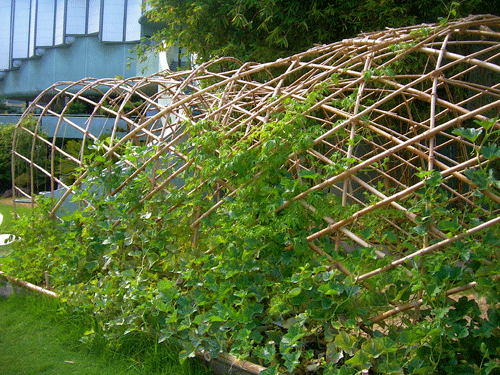
While the most relevant project of this variety is Lauren Bon's Reclaimed Strawberries—she's made a self-sustaining "flag" of strawberries with found fruit and collaboration with casualties of the military—easier on the eye is Fallen Fruit's on-site garden tressel. Even though gained at the cost of death, in other words, art making life right before our eyes.

Now, it might be interesting to consider this almost compulsive performance of artists' ability to create (or facilitate) life against the waning of older ideas about art's vitality or liveliness. Not only am I thinking of ancient and early modern tropes of images so illusionistically rendered that they seem to be alive, but conversations certainly present through Abstract Expressionism about the art-object as a living being. Has a loss of belief in art's vitality, in other words, come to compel these concretized performances of its alive-ness?


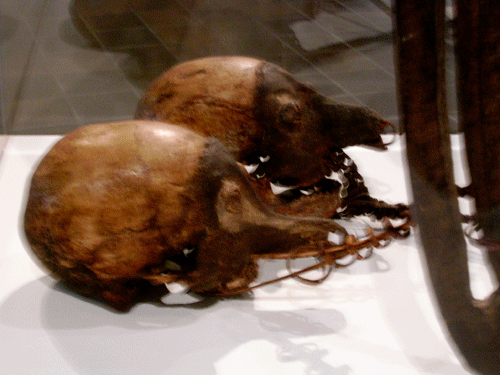
Strolling back into the museum with these admittedly mandarin questions in mind, this object brought the issue right down to brass tacks. Described in the gallery (but in much more detail here) only as a "Skull Rack" from Papua New Guinea ...


... this stylized, quasi-humanoid art object has reduced the humans to rat-like skulls with cowrie shells for eyes. And it literally has them by the nose. Old Ken doesn't know too much about the art of New Guinea, but I'm guessing that you don't need a PhD in anthropology to begin understanding who controls death and life, in that order, in this piece. If only that LACMA was equally transparent about the issue!

Labels: , , ,

Monday, June 07, 2010

Seed-pod fun


While out hiking in the San Gabriel foothills last week, I came across this seed pod. It grows on a creeping, morning glory-like vine and, when discovered, it was fully sealed.


After keeping it at home in a dish for three days, the bottom split open (as suggested in the image) to reveal four massive brazil-nut-like seeds. When the seed pod dries (more images to follow!), it resembles a luffa.


In fact, looking online, I find this image of a species of wild luffa native to subtropical regions like Vietnam, which certainly resembles our specimen. But, how have they preserved the skin of this specimen so that it doesn't rupture? Possibly, this specimen was picked before it grew the thorns so perceptible in my object? In any case, if anyone can help with the identification of this curious beast, Old Ken would be most grateful.

Labels: , , ,

Monday, May 17, 2010

Carmina Escobar at Machine Project


This past weekend, Old Ken and Lady Marmalade were strolling by Machine Project just past the intersection of Sunset and Alvarado. What's happening in there, we thought to our selves? Turns out, a performance by avant-garde vocalist Carmina Escobar was a-brewing. Walking into the gallery, we found the room darkened and rocks strewn all over the floor. The audience had seated themselves in folding chairs set up in a "u." Flashlights directed inward from the elbow of the u cast the rocks into elongated shadows ...


... reminding yours truly of Samuel van Hoogstraten's visual meditations on shadow-play, which we see above.

To this point, Ms. Escobar was no where to be seen. She could be heard, though, chirping and howling quietly behind a scrim. When she emerged, she was singing with a light in her mouth -- a dazzling effect I've tried to suggest in the drawing above. Having traversed the gallery with the light in her mouth, Escobar then removed the light and crouched down before a rack of effects pedals. For the next twenty minutes, she used these devices -- recording, looping and interacting with her own voice - - to make inarticulate noises that nonetheless recalled and mingled with the local environment in interesting ways. A passage of bird-like trills gained in intensity, bleeding eerily into the siren of a passing police car. And juxtaposed by a suggestive bodily pantomime, Escobar's wordless melange of pitches and tones melded with the babel of tongues -- Spanish, Chinese, English -- of passersby on the street.

Perhaps this was the most interesting aspect of Escobar's work for Old Ken: the mixing, the literal confusion of stimuli. With light and sound confounded in her mouth, for example, Escobar also held a magnifying glass before her lips as she chirped and howled -- amplifying the visual appearance of her teeth and I suppose, poetically if not practically, augmenting her noises. In the end, the audience (who had to that point acted as little more than sound-dampeners on the folding chairs) were brought into more robust service. The artist escorted each of us out of our seats and began blowing resonating vibrations into our backs -- actions we were expected to repeat upon one another. Everything in the gallery, so the point seems to be, is part of the art, even as the art inside is inseparable from the accidents (the sirens, the street talk) bleeding in from without. This, no doubt, could be taken to the more metaphysical level begged by Escobar's title for the piece (The Cave) and her repeated incantations near the work's climax (about being "the anima in the cave"). But I'll spare you those high-jinks. For now.

Labels: , , ,

Saturday, December 12, 2009

Whatcha doin' there, friend?


"Say, friend. Whatcha got goin' on there? That looks like kind of a funny way to read a book. What's all the business surrounding you? I'm a little confused.


"I'm looking at what you're doing, and I like it. But -- BUT -- it strikes me that you must have two books in front of you, one a foot further away from you than the other. I know I could be doing it wrong, but I guess when I read a book, I always try to read just one at a time. And what are those things appended to your armature? Are those mirrors?


"What in the Sam Hell are you up to, friend?"

"What's that?" http://linguafranca.mirror.theinfo.org/9706/fieldnotes.html

"Oh, now I see. I think. What's that you say? 'Crazy is as crazy does.' Amen, brother. Amen."

Labels: , ,

Saturday, December 05, 2009

What you Learn from Archives: Part II

A fine picture this, A Boy in Fancy Dress by early eighteenth century painter Nicolas de Largillière. The painting was purchased at auction by the agents of J. Paul Getty in the early 1970s and currently is on display at the Getty Museum. But, what exactly are we looking at? Who is this character all kitted out in his fancy Roman garb? And what kinds of questions are we to ask of a picture like this?

Opening the object files at the Museum provides some interesting clues. In 1982, the painting was lent to an exhibition at The Montreal Museum of Fine Arts for an exhibition. “I understand that you have heard about all of the problems we had with the local public reaction to the exhibition," so the head curator in Montreal wrote to the Getty. "It was an extremely difficult time for me.” What had happened? Had M. Largillière himself arisen from the grave an criticized the hanging of the pictures?

Apparently - - and presumably among other things - - this curator in Montreal had gotten into a disagreement the identity of the sitter in Largillière’s painting with the then-director of the Louvre, Pierre Rosenberg (who seems to be posing as a pope in the photo above). While the Montreal curator claimed that the sitter depicted was a youthful Louis XV, Rosenberg said it was the “Old Pretender,” James-Francis Edward Stuart. This disagreement had to do, centrally, with iconography. As the Montreal curator explained: “For Rosenberg, the absence of the fleur de lis or the ordre de St. Espirit, as well as the symbol of the goldfinch as reference to exile, would support the view that the little boy would represent James Francis Edward Stuart. (He tried to return to England in 1706, 1708, and 1715). I myself believe that the absence of the ordre de St. Espirit as well as the fleur de lis could be explained if the portrait were painted before the death of Louis XIV in 1715, i.e. before the future Louis XV was officially recognized as the heir to the throne.”

With this cloud over the identity of the sitter, the Getty folks then wrote to Aileen Ribeiro at the Courtauld Institute of Art in London, asking her to sort the issue out. Calling attention to “the emblematic goldfinch perched on a thornbush”, the Getty folks parsed the key issue this way: “[The Montreal curator] sees it as a reference to the tragic deaths of Louis XV’s parents and brothers by the time he was two years old, and also a reference to the hope for his own survival and prosperity. Pierre Rosenberg, however, recognizes it as a reference to exile.” They ask Ribeiro, a now-retired expert in the history of costume, to narrow down the date of the painting’s production based on “the type of fancy costume the child wears and his hair style.”

Ribeiro’s response was strongly deflationary: "It is virtually impossible on the basis of the costume to assign an exact date to this; on the basis of the hairstyle a date in the 18th century would be more likely (it could be even into the 1720’s), but very often the simple hair worn by children anticipates that of adults later. The costume is probably a theatrical or masquerade costume, Roman dress; from the details (such as the wrinkled hose, in imitation of bare legs) I think this is a real costume, and not merely an artistic convention. ... One or two other points; although the features of the boy are not unlike those of the adult James Francis Edward Stuart, surely his hair was brown, as he was quite swarthy? I agree that it is unlikely that in any event Louis XV would have been portrayed without the St. Espirit."

And here is the dagger: “What I am saying is that I think it is a portrait of an aristocratic boy in fancy dress, and if pushed I would give a date in the first decade of the 18th century, but it could as easily be the 1690s’s or as late as the 1720’s.” Thus, neither the evidence of painting style, iconography, nor costume provided sufficient data by which to establish exactly the picture was executed and, more importantly, who it depicted.

The folks at the Getty clearly took Ribeiro's assessment seriously. Immediately after it was received, they began dispatching letters to other experts -- including Rosenberg -- soliciting identifications. And, as the Getty curator's letter to Rosenberg indicates, Ribeiro's interpretation had been followed hook, line and sinker. While it had been postulated that "the boy represents the duc de Bretagne," so the Getty reported to Robenberg, "I am also skeptical, however, about the identification of our boy as James Francis Edward Stuart, whose complexion and hair were darker. A date in the early 1690s also seems too early for our painting on the basis of style."

While Rosenberg then responded with incredible grace demuring that he is "nothing like" an expert on Largillière, the identity of the sitter henceforth remained unspecified. So, as the authorship of Largillière never seems to have been contested in this case, the key issue for assigning scholarly (and monetary) value lay in the identification of the sitter. If this was the dispute, upon what did our confederation of scholars agree?

The first shared presumption was that the picture did depict someone—Largillière, a well-known portrait painter, was not simply doing this painting as an imaginative caprice. Further, all interpreters assumed that the features in the picture might possess telling iconographical or symbolic significance; by knowing what the goldfinch signified, the identity of the sitter and conditions of image-production could be revealed. Finally, and somewhat in contradiction to the former point, it was assumed that the depicted hairstyle and clothing might well reflect then-current fashion trends; so, if the fashion depicted could be dated, then the date of the painting's production could safely be inferred.

Needless to say, nothing is mentioned in this correspondence of the nature of the dog, the character of his relationships to the boy and to the bird, or indeed why it would have been desirable for any of the nobility named above to have posed for such a weird picture. Curiouser and curioser, sir! Curiouser and curioser indeed.

Labels: , ,

Monday, November 23, 2009

"Emotional Lubricant"


Dear Milt:

Hate to have to tell you this, but I think you left your copy of Morty Feinberg's *Effective Psychology for Managers* on the plane.


Yup, that's right. You must have left it on that flight to Dallas/Fort Worth we took back in July.


Actually, looks like you were reading a section called "Why We Need Our Disguises":

"At some time or other, every individual feels the need to hide his inner feelings behind some sort of curtain or disguise. In fact, some psychologists claim that personality itself is a disguise. The very word, in fact, comes from the Latin 'persona,' which means facial disguises."

That Morty. He sure loves his facts.


But, hang on, Milt. Now, that I'm looking here, maybe you left the book on that flight we took from Atlanta back to LA. I sure can guess what you were reading then!


Be Enthusiastic

A moderate amount of flag-waving is helpful. At least convey the impression that your project or idea is appealing.

You must believe in something, and demonstrate that belief through enthusiasm, before you can be successful at persuasion. Your own enthusiasm is the best emotional lubricant for others. When they, too, become enthusiastic, they'll find it easy to agree.

"Emotional lubricant"? Really, Morty?

Well, Milt, I always have enjoyed our trips together. A pinch for the kids, and slap that wife on the fanny for me.

—Scooter

Labels: , , ,

Saturday, November 07, 2009

Fake! A Story from the Archives


So, there was Old Ken in a certain library the other day. This library was hosting a book sale where my eye happened to fall upon the book represented above: Fake by Clifford Irving. Price? $2! Now, as you must know by now, forgeries and faking is a topic of no small interest to Old Ken, so I had to have a look.

You can imagine my delight as I read the opening paragraph of the first chapter, which goes like this:

"In the summer of 1961, ... a dapper, middle-aged, expatriate Hungarian bachelor gentleman calling himself Elmyr Dory-Boutin rented a comfortable suburban house on the Spanish Mediterranean island of Ibiza. His hair was dyed an apparently ageless jet black, he sported a monocle on a gold chain, all his sweaters were of cashmere, and during his seven-year residence on the island he came to wear a wristwatch from Cartier and drive a red Corvette Stingray convertible." (p. 3)

Obviously, you can imagine that Old Ken would like the cut of this man's jib!


Well, it turns out that our bachelor gentleman is less Hungarian royalty than a forger of Van Gogh, Renoir, Pissarro and others named Elmyr de Hory who was hiding out on Ibiza to avoid extradition.


As if that were not enough, it turns out that stuffed into this particular copy of Mr. Irving's fine book is a packet of documents including a letter from one Kendrick Talbot of London. Basically, the story is this: Talbot was a London book-maker who had made a fortune in the gambling business before retiring to Ibiza in the 1960s. There, he met de Hory, a compulsive gambler and spendthrift. Because De Hory was constantly losing money to Talbot, he would give Talbot the supposedly-authentic modernist paintings he claimed to be collecting as collateral against his debts.


Well, after de Hory's hoax was exposed in the 1970s, Talbot who claimed not to "know a painting from a bar of soap" sought to bring the paintings to market as "authentic fakes" or real de Horys.


As you can see, some of these are more convincing than others. While the "Modigliani" at upper right here is fairly respectable, the supposed Toulous-Lautrec below it is hopeless.


Anyway, the photos reproduced here were attached with the letter as Talbot was trying to hawk the paintings represented to one Mr. Jack Glenn of Long Beach at the prices denoted above. The epigraph to the book by our Mr. Clifford Irving - - who, interestingly enough, was put in jail for writing a libelous biography of Howard Hughes - - says it all: "If fools did not go to market, cracked pots and false wares would not be sold."

Labels: , ,

Friday, August 28, 2009

Forest Fire!


A pleasant enough day in August on the hot and sleepy Caltech campus. You can almost watch the tumble-weeds blowing by, tossed around in the wake of the various carts and aspiring cars that propel people around the entirely-flat and less-than-a-square-mile-large campus.


But, let's take a little bit of a closer look: what have we got here? That's right, a major forest fire in the Angeles National Forest. I guess no hiking for Old Ken this weekend!

Labels: , ,

Saturday, May 30, 2009

May Grey/June Gloom


Here in the southland, early summer brings some strange weather. Clouds linger through the mornings, burn off in the early afternoon and then return in the evening. This is called "May grey" and "June gloom."


If you like some satellite images, check out this visualization of marine stratus clouds swirling along the southern California coast in mid-June 2004.


Well, for those who prefer more conventional pictures, take heart that the overcast conditions do nothing to minimize the beauty of the jacarandas. These lovely purple-flowered trees are now in full bloom ...


... and leaving their petals all along the streets and lawns.


I think you'll agree with me that this intermingling of green and purple answers well to certain strands of Post-Impressionist-inspired painting. I offer you here one of friend Michael Knutson's early lawnchair series as an example of what I have in mind. But surely you'll have your own references early to hand.


Sure, the absence of sun can be a little gloomy. But, it also invites a certain silent reverie in the face of scenes like this.

Labels: , ,